The pressure is real and it is building. Across Europe, CFOs and facility managers in commercial, industrial, logistics, and manufacturing operations are being asked the same question: where is the evidence that your energy strategy actually supports your ESG commitments — not just on paper, but hour by hour, through winter nights and summer weekends?
Solar installations helped many organisations take a first credible step. But solar alone answers only part of the question. The grid does the rest, silently, invisibly — and in ESG reports, that invisible grid still carries a carbon figure that auditors and investors are increasingly reluctant to accept.
This article explores what a complete, verifiable, year-round clean energy strategy looks like for industrial and commercial operations in 2026 — and why the combination of sodium-ion battery energy storage and small wind turbines is emerging as the most practical answer for sites where energy consumption does not stop when the sun goes down.
The 2026 ESG energy gap: what solar cannot cover
A rooftop solar array is a visible, tangible commitment. It generates clean energy, reduces grid dependency during daylight hours, and produces a straightforward number for the sustainability report. For many organisations it was the right first move.
But look at the energy profile of a manufacturing facility, a logistics campus, or a commercial building running shift operations, and the gap becomes obvious. Energy consumption runs continuously. Refrigeration, compressed air systems, conveyor lines, server rooms, HVAC – none of these wait for sunny afternoons.
The consequences of this mismatch are showing up in ESG reporting cycles. Scope 2 emissions — those from purchased electricity — remain elevated because the grid fills the gap that solar leaves behind. Auditors, rating agencies, and institutional investors are asking increasingly specific questions about when and how clean energy is consumed, not just how much is generated on an annual basis.
The answer is not more solar panels. The answer is a strategy that generates and stores clean energy across all conditions — including nights, overcast days, and the long European winter. That requires two things solar cannot provide on its own: storage and a complementary generation source that performs when solar does not. Annual renewable generation figures are giving way to hourly matching requirements in corporate sustainability frameworks. Organisations that can demonstrate clean energy availability around the clock — not just on average — will be significantly better positioned in the ESG disclosure environment of 2026 and beyond.
Battery energy storage: the foundation of a 24/7 clean energy strategy
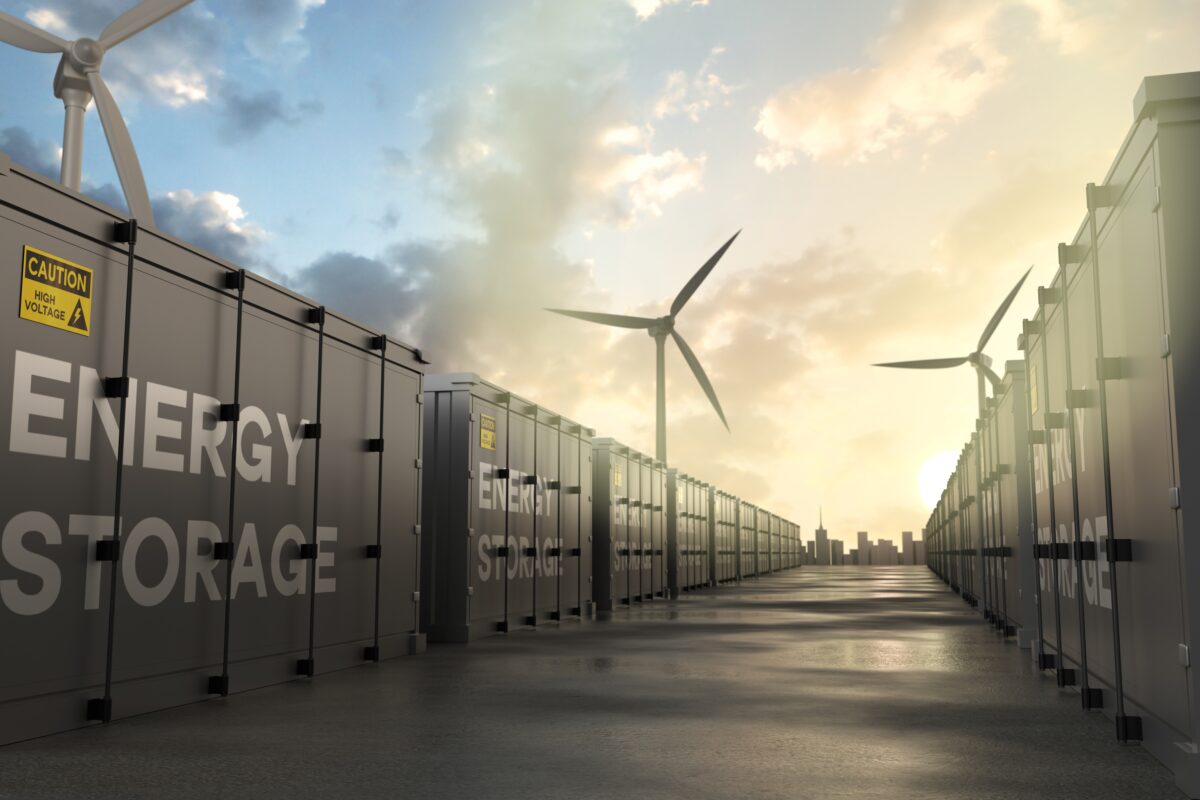
A battery energy storage system (BESS) does something fundamental: it decouples the moment of generation from the moment of consumption. Energy produced by solar during peak generation hours — or by wind turbines during high-wind periods — is stored and dispatched precisely when it is needed, including at night and during grid peak-price windows.
For commercial and industrial operations, the benefits of a battery energy storage system operate on two levels simultaneously.
Operational and financial benefits
Peak demand charge reduction is typically the most immediate financial lever. Grid tariffs for commercial and industrial consumers are heavily weighted toward peak consumption periods. A well-configured storage system shifts load away from these peaks, reducing the demand component of electricity bills substantially — often representing the single largest line item in the energy cost calculation.
Energy price arbitrage adds a second layer: charging storage when grid prices are low (often overnight or during high renewable generation periods) and drawing from storage when prices are high reduces average procurement cost. As European power markets become more volatile, this capability is increasingly valuable.
ESG and reporting benefits
From an ESG perspective, a battery energy storage system provides something auditors can actually verify: documented clean energy consumption, hour by hour, with a traceable source. Combined with on-site renewable generation, this supports Scope 2 market-based emissions reporting at a level of specificity that is difficult to achieve through grid power purchase agreements alone.
It also provides resilience — and resilience has its own ESG dimension. Supply chain continuity, operational reliability, and the ability to function through grid disruptions are increasingly recognised in ESG frameworks under the governance and risk management pillars.
High-voltage vs low-voltage systems: choosing the right architecture
Commercial and industrial storage deployments typically involve a choice between high-voltage and low-voltage battery architectures. High-voltage systems (above 48V, often operating at 400V or above) are better suited to larger-scale industrial applications where significant power throughput is required and three-phase integration with existing electrical infrastructure is standard. Low-voltage systems offer simpler installation and lower upfront integration costs and are more common in smaller commercial and light industrial contexts.
The right choice depends on the specific energy use profile of the facility — which is precisely why a detailed site assessment matters before any system is specified.
Sodium-ion batteries: why the chemistry matters for industrial ESG
Most discussions of battery energy storage focus on capacity and cost. Both matter. But for organisations with genuine ESG commitments — not just compliance targets — the chemistry of the battery itself has become a significant consideration.
Lithium-ion batteries, including LiFePO4 (lithium iron phosphate) variants, have dominated the storage market because of their energy density and cost trajectory. LiFePO4 in particular offers good safety characteristics and cycle life. But lithium-ion chemistries share a structural dependency on lithium, and often on cobalt, nickel, and manganese — materials whose extraction is concentrated in geopolitically sensitive regions, associated with significant environmental impact at source, and increasingly subject to supply chain scrutiny in corporate ESG disclosures.
What sodium-ion technology offers
Sodium-ion batteries replace lithium with sodium — the second most abundant element in the Earth’s crust, available in effectively unlimited quantities, distributed globally, and processed through significantly less environmentally intensive methods. The advantages this creates are not marginal:
- • No dependency on lithium, cobalt, or rare earth materials — removing the most contested supply chain elements from the ESG disclosure entirely
- • Superior performance in cold temperatures — a practical advantage for European operations where winter conditions affect lithium-ion performance and cycle efficiency
- • Inherently lower thermal runaway risk — sodium-ion chemistry is more thermally stable than standard lithium-ion, supporting safer indoor and space-constrained installation
- • End-of-life recyclability — the chemistry is better suited to closed-loop recycling, supporting circular economy commitments
Freen sodium-ion energy storage: made in Europe
Freen’s sodium-ion energy storage systems are designed and manufactured in Europe. This matters for several reasons that go beyond supply chain sentiment.
For organisations reporting under CSRD or preparing for its requirements, the provenance of major capital equipment — including energy infrastructure — is becoming part of the disclosure landscape. A storage system manufactured in Europe, using materials without contested supply chains, and designed to operate across the full European climate range is a materially different ESG asset than an imported lithium system, even if the kilowatt-hour specifications are similar.
It also means shorter lead times, local technical support, and alignment with emerging EU content requirements in public and private sector procurement.
Small wind turbines: clean generation when solar cannot deliver
Storage solves the dispatch problem. But storage needs to be charged from somewhere — and if that source is primarily the grid during low-price windows, the ESG case is weaker than it appears. The full strategy requires on-site renewable generation that operates independently of daylight.
Wind is the natural complement to solar for European industrial and commercial sites. Wind resources in Northern and Central Europe are strongest precisely when solar is weakest — in autumn and winter, and overnight. A facility that combines solar, wind generation, and battery storage has a fundamentally more resilient and verifiable renewable energy profile than one relying on any single source.
Small wind turbines for commercial and industrial applications
The perception that wind energy requires large-scale turbines and significant land area is accurate for utility-scale generation — but not for distributed on-site generation. Small wind turbines, typically defined as systems up to 50kW, are designed for installation at or near the point of consumption: within logistics campus perimeters, on manufacturing site boundaries, or alongside warehousing facilities.
Output is sized to contribute meaningfully to on-site demand rather than feed into the national grid. Combined with solar and storage, this contribution is often sufficient to reach the target of near-continuous on-site renewable supply.
Vertical axis vs horizontal axis: the key design choice
Small wind turbines come in two primary configurations, and the choice has practical implications for industrial site deployment.
Horizontal axis wind turbines (HAWT) are the familiar propeller design. They offer higher aerodynamic efficiency in consistent, unobstructed wind flows. For sites with open land areas and prevailing wind from a consistent direction — such as logistics parks on the outskirts of cities or manufacturing facilities in rural settings — horizontal axis designs typically deliver better output per unit of investment. The main advantages of a horizontal axis wind turbine are its efficiency in open conditions and its established maintenance record.
Vertical axis wind turbines (VAWT) accept wind from any direction without needing to reorient, making them better suited to urban and peri-urban environments where wind is more turbulent and directionally variable — rooftops, constrained perimeters, sites surrounded by other structures. Small vertical axis wind turbines also have lower cut-in wind speeds in some designs, meaning they begin generating at lower wind conditions than equivalent horizontal axis systems. Their lower profile can also be advantageous where planning constraints or aesthetic considerations apply.
Neither design is universally superior. The right choice depends on the specific wind resource profile of the site, the available installation space, and planning requirements — which again underlines why a site-specific assessment is the correct starting point.
Freen-9 and Freen-20: designed for European industrial conditions
Freen’s small wind turbine range includes two models optimised for commercial and industrial deployment across European climates:
The Freen-9 is designed for sites where space is more constrained and planning requirements are more sensitive — urban logistics facilities, commercial rooftops, and smaller industrial perimeters. Its compact form factor and low-turbulence acceptance make it practical for environments where a large turbine installation would not be viable.
The Freen-20 targets larger industrial and logistics campuses where higher output is required and installation space allows for a more substantial system. It is designed to operate efficiently across the wind speed ranges typical of Central and Northern European industrial sites, providing consistent generation through the autumn and winter months when solar output is lowest.
Both turbines are manufactured to European standards, with local service and support network coverage — directly relevant to the maintenance commitments that facility managers need to plan for when adding generation infrastructure to operational sites.
The integrated approach: storage plus wind as a system
The strongest ESG and commercial case is not made by any individual technology. It is made by the combination: solar generation during daylight hours, wind generation during overnight and low-light periods, and battery storage absorbing surplus from either source and dispatching it through demand peaks and generation gaps.
This integration transforms the energy profile of a facility from one that is merely “renewables-connected” to one that is genuinely low-carbon across a large proportion of its operating hours. It is the difference between a facility that generates renewable energy and one that demonstrably consumes it.
For CFOs evaluating the financial case, and for ESG officers building the disclosure narrative, that difference is significant. It answers the auditor’s question. It supports the CSRD disclosure. It provides the kind of operational resilience that is increasingly valued by institutional investors and corporate customers assessing supply chain sustainability.
The ROI question: why there is no universal answer — and why that matters
Any honest discussion of the financial case for energy storage and wind generation has to begin with a straightforward admission: the ROI calculation is different for every facility.
This is not a hedge or a caveat designed to avoid a difficult number. It reflects genuine complexity in the variables that determine the business case — complexity that, once understood, actually strengthens the argument for a site-specific assessment rather than weakening the case for investment.
Variable 1: the local wind resource
Wind generation output depends directly on wind speed at the site. A facility on an exposed logistics park on the fringes of a Northern European city may experience average wind speeds of 6–7 m/s — genuinely productive for a small turbine. A facility in a sheltered valley or dense urban environment may see half that. The difference in annual generation — and therefore in the contribution to the financial case — can be substantial.
This is why wind resource assessment is the non-negotiable first step before any turbine investment is sized or costed. A ten-minute conversation about average annual wind speeds at the site location is enough to give a preliminary steer on whether wind makes sense at all, and if so, which system is appropriately sized.
Variable 2: energy tariff structure and grid costs
The financial value of on-site generation and storage depends heavily on the structure of the energy tariff the facility is currently paying. Facilities on time-of-use tariffs with significant peak demand charges — common for larger commercial and industrial consumers — see much faster payback from storage than facilities on flat-rate tariffs. The specific tariff structure, contracted capacity, and demand profile together determine how much of the investment can be recovered through bill reduction rather than through generation value alone.
Variable 3: available incentives and financing structures
In 2026, the landscape of public incentives for renewable energy and storage investment in Europe remains active but highly variable by country, region, and technology type. Some jurisdictions offer direct grants for commercial renewable installations. Others provide accelerated depreciation, favourable green financing terms through state development banks, or EU-funded programmes targeting industrial decarbonisation. The presence or absence of an applicable incentive scheme can shift the payback calculation by years.
Financing structure matters equally. A fully self-funded capital investment is assessed against a different hurdle rate than a green lease or an energy-as-a-service arrangement in which the upfront cost is absorbed by a third party and recovered through contracted energy savings. Both structures are available in the market; the right choice depends on the organisation’s capital allocation priorities and balance sheet considerations.
Variable 4: the energy use profile of the facility
How a facility consumes energy — the shape of its demand curve across hours, days, and seasons — determines how effectively storage and generation assets can be integrated. A facility with very consistent baseload consumption, like a cold store or a continuous-process manufacturing plant, presents a different optimisation problem than one with highly variable demand peaks driven by shift patterns or batch processes.
Understanding the demand profile is what allows a storage system to be correctly sized: large enough to cover the gaps and peaks that matter most, not oversized in ways that add capital cost without adding proportionate value.
Variable 5: the value of resilience — a number that can rewrite the equation
There is a fifth variable in the ROI calculation that conventional energy finance models systematically undervalue, because it is probabilistic rather than guaranteed: the value of avoiding a critical outage.
Grid disruptions — whether caused by extreme weather, infrastructure failure, or the increasing stress that renewable intermittency places on distribution networks — are not hypothetical for European industrial operators. They happen. And when they happen, the cost is rarely just the value of the lost electricity. It is the cost of interrupted production, spoiled inventory, missed delivery commitments, emergency response, and in some cases regulatory consequences.
A facility with on-site generation and storage has a degree of protection against these events. A single avoided outage — particularly one affecting a critical system — can deliver a financial impact that equals or exceeds the entire cumulative benefit of energy bill savings over years of normal operation. That does not mean the investment should be justified on resilience grounds alone. But it does mean that a financial model which excludes resilience value entirely is almost certainly understating the true case.
This is especially relevant for logistics and manufacturing operations with contractual delivery obligations, facilities operating safety-critical processes, and data or communications infrastructure where continuity is a legal or commercial requirement.
The honest answer to ‘what is the ROI?’
We cannot give you a reliable number without knowing your site. But we can tell you this: for the commercial and industrial facilities we work with across Europe, the combination of the right wind resource, an applicable incentive scheme, an appropriate financing structure, and an honest accounting of resilience value consistently produces a business case that is compelling — often more compelling than the initial estimate suggested.
The starting point is a conversation about your specific situation. That conversation is free, and it is the only way to get a number you can actually use. Contact us at contact@freen.com and schedule a consultation today.
What this looks like in practice: two operational profiles
Commercial and industrial operations with active ESG reporting requirements
For organisations with ESG reporting obligations — whether driven by CSRD, investor requirements, or supply chain commitments from major customers — the challenge is not usually motivation. It is evidence.
A CFO preparing an ESG disclosure needs to be able to say, with documentation, that a specific percentage of the facility’s energy consumption came from verified on-site renewable sources, and to show that this percentage is improving. Battery energy storage combined with on-site wind generation provides exactly that documentation infrastructure, because the generation, storage, and dispatch events are all logged and attributable.
Beyond the reporting value, the financial case for this profile typically centres on peak demand charge reduction — often the largest single lever available — combined with the reputational and commercial benefit of credible ESG differentiation in procurement processes and investor communications.
Industrial logistics and manufacturing campuses with high, continuous consumption
For logistics and manufacturing operations, the case is more operationally grounded. These facilities run continuously. Their energy bills are large. Their exposure to grid disruptions is costly. And solar alone — however well-designed — simply cannot address the night shift.
The integration of small wind turbines with sodium-ion storage creates a generation and dispatch system that is genuinely aligned with the operating pattern of a 24/7 facility. Wind generates through the night and through winter. Storage absorbs surplus and covers demand peaks. The grid supplements, rather than dominates.
For facilities in this profile, the ESG dimension and the operational cost dimension reinforce each other rather than competing. Investment in clean energy infrastructure is simultaneously a cost management decision, a resilience investment, and a contribution to Scope 2 emissions reduction — three separate lines in three separate business cases, all addressed by the same system.
Made in Europe: more than a selling point
The phrase ‘made in Europe’ has taken on substantive meaning in the energy infrastructure market since 2022. The combination of supply chain disruptions, geopolitical risk reassessment, and the growing specificity of ESG supply chain disclosure requirements has changed how procurement teams and CFOs evaluate the provenance of major capital equipment.
From an ESG disclosure perspective, this matters in two specific ways. First, it supports Scope 3 reporting: the embodied carbon in manufacturing is lower and more accurately calculable for a European-made system. Second, it supports governance disclosures related to supply chain risk management — increasingly a focus area for ESG rating agencies and institutional investors assessing long-term operational risk.
It also means that when something needs to be serviced, the expertise and the parts are in the same time zone.
The right next step: a conversation about your specific situation
Every facility is different. Wind conditions, energy tariff structure, demand profiles, planning constraints, available incentives, financing preferences, and ESG reporting requirements all vary — and all affect the usiness case.
What we know from working with commercial and industrial operators across Europe is that the right answer almost always looks different from the initial estimate — sometimes better, occasionally more complex, but consistently more precise and more useful than a generic projection.
A preliminary assessment typically involves a short briefing on current energy consumption patterns, a review of available wind resource data for the site location, and a discussion of current ESG reporting requirements and financial parameters. From that starting point, we can provide a directional view of the system configuration that makes sense, and the rough parameters of the business case — before any commitment is required.
Get your facility’s energy assessment
Talk to the Freen team about your site. We’ll review your wind resource, energy profile, available incentives, and ESG requirements — and give you a real number for your situation.
Contact us at contact@freen.com