Solar panels have transformed European rooftops — but they have a problem that nobody talks about enough. In the depths of winter, when your heating is running and daylight lasts barely eight hours, your panels are producing almost nothing. That gap is precisely where a small wind turbine earns its place, and why more European homeowners are taking the technology seriously.
Europe’s energy bills have changed everything. What was once a niche interest for eco-enthusiasts has become a serious financial calculation for ordinary homeowners: could generating your own electricity — including from the wind — actually make sense? Small wind turbines, once dismissed as impractical for residential use, deserve a much closer look. Can a small wind turbine genuinely cut energy bills? After years of high energy prices, volatile gas markets, and growing interest in energy independence, the idea has never been more appealing.
What Is a Vertical-Axis Wind Turbine?
Most homeowners imagine a wind turbine as a tall tower with spinning blades facing into the wind. But the technology best suited to gardens, rooftops, and suburban settings works on an entirely different principle, and once you understand how, the appeal becomes obvious.
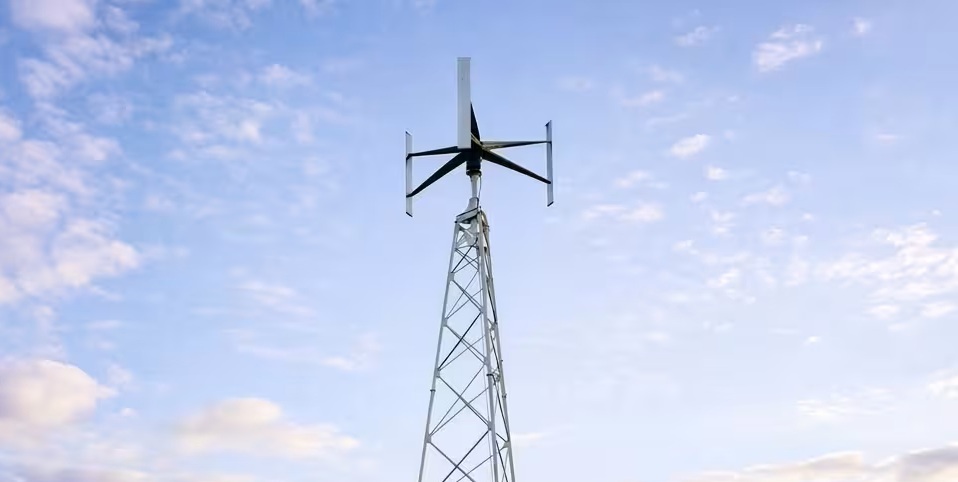
A vertical-axis wind turbine (VAWT) rotates around a vertical shaft rather than a horizontal one. This single design difference has profound practical consequences for residential use.
Because the shaft is vertical, the turbine captures wind from any direction without needing to physically rotate to face the wind. This is the VAWT’s defining advantage in real-world residential environments, where wind is rarely steady or predictable.
How VAWTs work in practice
The blades of a VAWT sweep around a central vertical column. As wind strikes the blades from any angle, the rotor turns, driving a generator that converts the motion into electricity. Because the generator and key mechanical components are located at the base — not at the top of a tower — VAWTs are easier to install, easier to service, and far less visually intrusive than traditional designs.
Modern VAWTs are engineered to start generating electricity at wind speeds as low as 2–3 m/s (roughly 7–11 km/h), making them genuinely usable in the moderate wind conditions that characterise much of central and western Europe. They also continue operating safely in strong gusts without the need for complex automatic shutdown systems.
The two main VAWT designs
Darrieus turbines like Freen-20 or Freen-9 use curved or straight lift-based blades — similar in principle to an aircraft wing — to generate rotation. They are more efficient in consistent moderate winds and make up the majority of the residential VAWT market.
Savonius turbines use drag-based scooped blades and are exceptionally good at starting in very low winds. They are simpler mechanically and extremely durable, though somewhat less efficient at higher wind speeds.
Many modern residential designs combine elements of both to get the best of each: reliable low-wind startup with efficient operation across a broad range of conditions.
VAWTs vs. Traditional Turbines: What Actually Matters for European Buyers
The conventional wisdom that VAWTs are ‘less efficient’ than HAWTs is technically true in ideal, open-field conditions — but it misses the point entirely for most European buyers. Efficiency in a laboratory wind tunnel is irrelevant if the turbine cannot be legally or practically installed on your property.
The more useful question is: which technology actually works where you live? Here is a direct comparison across the factors that matter most to European homeowners:
| Factor | Vertical-Axis (VAWT) | Horizontal-Axis (HAWT) |
| Wind direction | Captures from any direction — no adjustment needed | Must physically rotate to face the wind |
| Performance in turbulence | Performs well — designed for variable, gusty wind | Loses significant output in turbulent conditions |
| Low wind speed performance | Starts generating from ~3 m/s; suited to European averages | Generally needs 4–5 m/s minimum for useful output |
| Land requirement | Minimal — small garden installation possible | Typically requires 1+ acres of open, obstacle-free land |
| Tower height | Low-profile; often under 5 metres or rooftop-mounted | Requires tall towers (10–30 m) to clear obstructions |
| Noise | Near-silent — typically under 45 dB at residential distances | Audible aerodynamic and mechanical noise |
| Bird and bat safety | Slower blade speeds — significantly lower wildlife risk | Higher risk due to fast-moving blade tips |
In open, consistently windy rural terrain, a HAWT will extract more energy per unit of equipment. But for the vast majority of European residential buyers — in towns, suburbs, coastal settlements, or properties with nearby trees or buildings — a VAWT is not only more practical, it is often the only viable choice.
Wind vs. Solar in Europe: A Genuinely Useful Comparison
Solar panels have had an extraordinary decade in Europe. Prices have fallen sharply, installations have become routine, and most European homeowners now understand the basic proposition. So why consider wind at all?
The answer is that wind and solar are not competitors — they are complements. And for European buyers, the case for combining them is particularly strong.
The seasonal mismatch problem
Solar panels in Europe face a fundamental challenge: they produce the most electricity in summer, but European households consume the most energy in winter — for heating, lighting, and hot water. In December and January, a rooftop solar installation in Germany, Poland, or the UK may produce only 10–15% of its summer output. This is not a flaw in the technology; it is simply the reality of solar in northern latitudes.
Wind behaves in almost the opposite pattern. European wind resources are strongest in autumn and winter — precisely when solar generation is weakest. A VAWT installed alongside solar panels therefore fills in the seasonal gap rather than duplicating it.
| Factor | VAWT Wind | Solar Panels | Wind + Solar Hybrid |
| Winter generation | Strong, peaks in winter | Weak in northern Europe | Excellent year-round |
| Summer generation | Moderate | Excellent | Excellent year-round |
| Night-time generation | Yes, if wind is blowing | None | Yes |
| Urban/suburban suitability | Good with VAWT | Excellent | Excellent |
| Planning complexity | Low for VAWTs | Very low | Low |
| Energy independence | Partial | Partial | High |
| Best suited for | Exposed sites, winter-heavy climates | South-facing roofs, sunny regions | Most European homeowners |
Energy Independence: Why It Matters More Than Ever in Europe
Before 2022, energy independence was primarily an environmental argument. Since then, it has become an economic and security argument too. Electricity prices across Europe rose sharply following the gas supply crisis and have remained volatile. For many European homeowners, the appeal of generating their own electricity has as much to do with insulation from price shocks as with environmental values.
A VAWT contributes to this directly. Every kilowatt-hour generated on your property is one less purchased from the grid — at whatever price the grid happens to be charging that day. In combination with solar and storage, a well-sized system can dramatically reduce — and in some cases effectively eliminate — dependence on grid electricity for much of the year.
Average household electricity prices in Europe more than doubled between 2020 and 2023 and have remained elevated. In this environment, the payback calculation for home energy generation has improved significantly. A VAWT that would have taken 15 years to pay back in 2019 may now pay back in 8–10 years, depending on location and local electricity tariffs.
Is a VAWT Right for Your Property?
A VAWT can be a strong investment for the right property — and a poor one for the wrong one. Here is how to assess your situation honestly:
Good signs — a VAWT is likely worth investigating:
- • Your property is exposed: on a hill, near the coast, or with open aspect in the prevailing wind direction
- • You can feel the wind regularly at your property, not just occasional gusts but consistent breeze
- • You already have solar panels and want to extend your self-generation into evenings and winter
- • Your electricity bills are high — making payback faster and the economics more compelling
- • You have a suitable rooftop, garden wall, or open garden area for installation
- • You are in a location with strong winter winds — northern Europe, coastal areas, exposed highlands
A small wind turbine won’t be the right fit for every home — but for the right property, it can be a genuinely transformative investment, delivering clean electricity through the long winter months when solar falls short and energy prices bite hardest. Combined with solar and storage, it brings energy resilience within reach for more European homeowners than ever before.
Ready to find out if your property is a good fit?
Get in touch with our team — we’ll assess your location, walk you through your options, and help you build an energy setup that works for your home.
Write us at contact@freen.com