

Energy You Generate. Keep Control.
Build your own energy system. Small wind turbines and battery storage designed for Germany, Austria, and Switzerland.
Electricity prices are rising, and grid connections take months. Freen offers a reliable alternative: generate your own electricity with a small wind turbine, store it in a sodium-ion battery, and use it anytime you need it.
Why Energy Independence Matters in the DACH Region
Electricity tariffs keep growing, and a solar panel that works great in July produces a fraction of that in January. Here’s how small wind turbines and energy storages address these issues:
-
Grid
CongestionIn Germany, commercial grid connection requests are taking six to twelve months to process through the Bundesnetzagentur. Swiss industrial zones are hitting network saturation limits that utilities cannot resolve quickly. Building your own generation capacity means the queue is irrelevant.
-
Rising Electricity Prices
Germany's Netzentgelte add a fixed burden on top of already volatile wholesale prices. Switzerland has the second-highest industrial electricity costs in Europe, with new federal levies appearing each year. A Freen system produces electricity at zero marginal cost once it has paid itself back.
-
Winter
Solar GapNorthern Germany, the Swiss Plateau, Bavaria, and Austria all share the same seasonal problem: low irradiance from October through March. Wind is at its most productive in exactly those months. Hybrid wind-solar systems naturally balance this seasonal gap for year-round energy security.
-
Lithium Battery Risks
Insurance restrictions and fire risks are increasing. Sodium-ion batteries produced in the European Union offer a safer alternative with stable performance: no thermal runaway risk and simpler compliance for commercial and agricultural installations.
Wind and Battery Storage: Energy That Works 24/7
Wind does not follow office hours. In Germany, Switzerland, and Austria it peaks in autumn and winter when heating demand rises, and grid stress is highest. A Freen turbine generates through the times that expose weakness of a solar-only system.
Our sodium-ion batteries hold what you generate and release it precisely when the cost of drawing from the grid is highest. The system works around your consumption pattern, not the market's schedule.
-
The Grid
BypassFor any business that cannot afford to wait twelve months for a grid upgrade, own generation is the immediate alternative, cutting both exposure to tariff increases and dependence on infrastructure you have no influence over.
-
Current
IncentivesKfW and BAFA in Germany, the KEV/RPC federal scheme in Switzerland, and Austria's Klima- und Energiefonds alongside the Renewable Energy Expansion Act (EAG) all support businesses and property owners who invest in decentralised renewable generation.
-
European
ProductionFreen sodium-ion batteries are designed and built in Europe. No lithium, no cobalt, no risk of thermal runaway. That translates to cleaner compliance documentation.
Not sure if own power generation is a solution for your energy challenges?
Download our guide and learn more about what you can gain with Freen energy solutions.
*By submitting your email, you agree to receive the PDF guide and marketing communications from us.
Wind and Storage That Work as One System
Our 9 kW and 20 kW turbines are designed to pair with sodium-ion battery storage from day one. Run them as your primary generation source or integrate them with existing renewables to cover the seasons and hours that solar cannot reach.
-
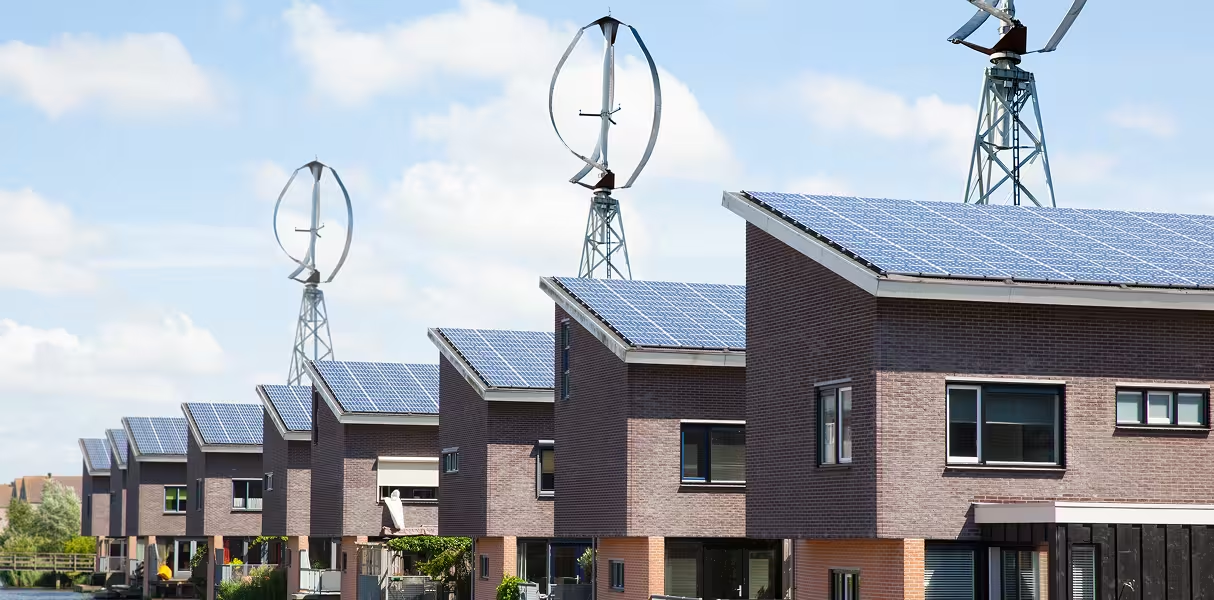
Wind Turbines
Small wind turbines that harness renewable power for consistent energy generation.
-
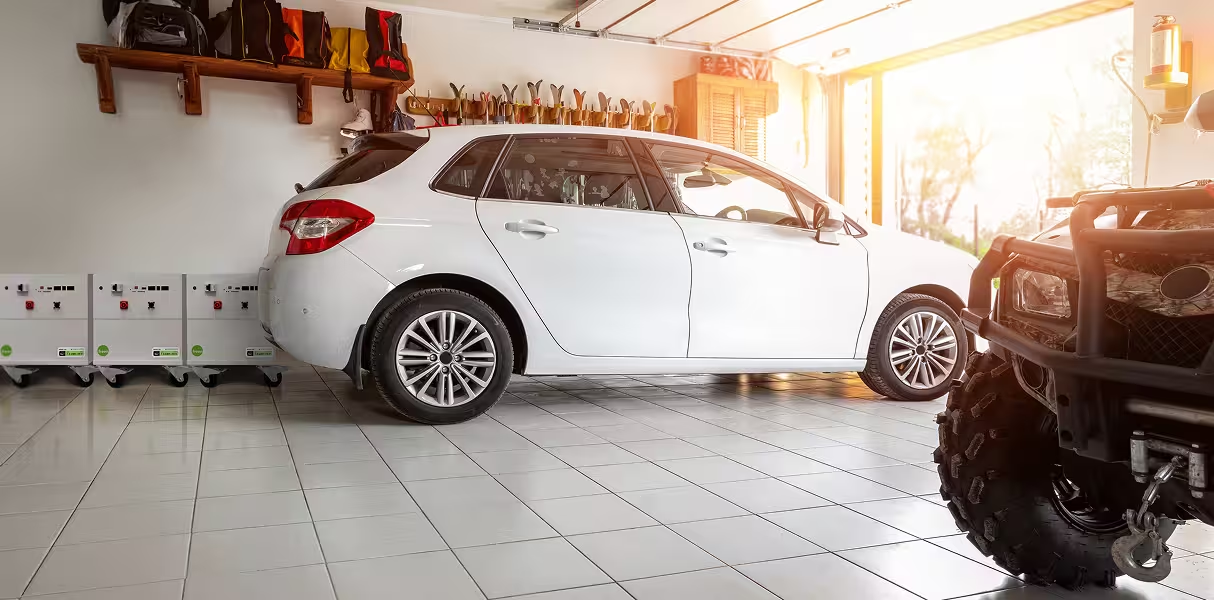
Energy Storage
Store surplus power to ensure uninterrupted energy supply, even during outages.
Self Power Generation in Germany, Austria and Switzerland
Germany needs to upgrade 40,000 km of grid infrastructure by 2040, a target that will take decades and offers no short-term relief to businesses stuck on connection waiting lists today. Swiss industrial customers already pay the second-highest electricity prices in Europe. In Austria, renewable demand is expanding faster than the network can absorb it. Across all three markets, the coldest and most energy-intensive months of the year are precisely when wind generation is at its peak. That seasonal alignment fundamentally changes what small-scale wind can deliver.
Freen 9 kW and 20 kW turbines are specified for the wind profiles and regulatory frameworks that apply in Germany, Switzerland, and Austria. The sodium-ion batteries are safe alternative to lithoum and complement the system. If you run a business in Bavaria waiting on a grid connection, a farm in Lower Saxony calculating your energy costs, or a property in Switzerland looking at what the next decade of tariffs will cost you, these systems are built for your situation.

Find out which energy system is best for your site.
Get consultationChoose Your Path
Whether you are a homeowner, farmer, or business, Freen has an energy system sized for you. Browse our products, get in touch, or explore our partnership program.
-
Solve your grid congestion issues and secure a predictable energy solution for businesses
-
Transform your current energy generation system into full powered backup
-

Join our network. We provide the hardware; you provide local relationships
FAQ
-
Output depends on average wind speed, which varies significantly by location. A 9 kW turbine at a well-exposed site, like coastal or open-plain locations in northern Germany, elevated agricultural land in Austria, or exposed sites on the Swiss Plateau, typically produces between 6,000 and 18,000 kWh per year in average wind conditions. A 20 kW turbine under the same conditions can reach 18,000 to 43,000 kWh annually. We run a location-specific generation estimate for every enquiry, using wind data for your exact coordinates, before you make any decision.
-
A 9 kW VAWT system starts from around €12,000 before mast and installation, with total project costs varying by site conditions, mast height, and whether grid feed-in connection is required. KfW loans and BAFA grants in Germany, regional programmes in Switzerland, and the Klima- und Energiefonds in Austria can reduce the net investment significantly. For well-sited systems, payback periods typically range from six to twelve years. After that point, every kilowatt-hour the turbine produces is free. We include a detailed cost and return model in every quotation.
-
Solar and wind are complementary. While solar peaks in summer daylight hours, the wind is often strongest in autumn and winter. Also, wind turbine generates power at night. Installing both with a shared battery storage system means your property produces clean energy across all seasons and times of day. Such energy system reduces what you need to draw from the grid. Contact us to confirm you existing setup compatibility with Freen products.
-
There are some reasons that matter specifically in the DACH market. Safety: sodium-ion cells cannot experience thermal runaway, which is the failure mode behind the lithium battery fires that are now causing European insurers to tighten or surcharge commercial storage policies. Cold-weather performance: sodium-ion retains its rated capacity at low temperatures significantly better than lithium-ion. Sodium is abundant and carries none of the cobalt or lithium extraction dependencies that create ESG reporting complications for businesses.
-
It is often the best option. Agricultural land typically provides the open exposure and lack of obstructions that produce the highest wind yields. Farms run energy-intensive equipment continuously which means a turbine's output can be absorbed directly rather than fed back to the grid at lower rates. A 20 kW system on a farm in Niedersachsen, Brandenburg, or Niederösterreich can offset a substantial portion of annual electricity spend. Specific grant programmes in Germany and Austria are structured to support agricultural energy investments, and we model the return for each operation individually.
-
In Germany, requirements vary by state and mast height. Below 10 metres, many states require only a simplified construction notification (Baugenehmigungsfreiheit or Kenntnisgabeverfahren depending on the state), not a full building permit. Above that height, a Baugenehmigung is required, and protected landscape or nature zones add further conditions. In Switzerland, cantonal regulations govern the process and differ considerably between cantons. In Austria, state building codes apply with their own thresholds and notification procedures.
Ready to take the first step?

Thank you for
contacting us!
Your message has been successfully sent. Our team will review it and get back to you as soon as possible. We appreciate your interest in our products and services.

We use cookies
Our website uses cookies to collect statistical visitor data and track interaction with direct marketing communication. If you agree, press ‘I agree‘. We will not place cookies on your device if you do not agree. However, certain functions of the website may not function properly or may not function at all. You may withdraw your consent at any time. Please see our Privacy Policy for more information about cookies, data they collect, who may access them, and your rights.