

Energy Security for the UK & Ireland
Generate and store your own energy.
Rising electricity prices, grid connection delays, and increasing pressure on infrastructure are reshaping how energy works across the UK and Ireland. Take control with a system designed for local conditions: generate reliable power with wind, store it safely with sodium-ion batteries, and use it when it matters most. Wind energy performs when solar cannot, while storage ensures uninterrupted availability for your home or business.
The Energy Landscape in the UK & Ireland is Changing
Are you prepared for rising costs, grid constraints, and energy uncertainty? Here’s how small wind turbines and energy storages address these issues:
-
Electricity Price Volatility
Generating your own wind energy replaces bought electricity at current retail rates (27–34p/kWh in 2026) with power you produce for the lifetime cost of the system. Fixed generation costs mean fixed budgets.
-
Grid Connection Delays
The total demand connection queue reached 125 GW in June 2025, up from roughly 41 GW in November 2024. Businesses are being forced to postpone expansion due to limited grid capacity. On-site wind generation bypasses the grid connection queue entirely.
-
Solar Limitations in Winter
A typical UK solar installation generates 65–75% of its annual energy between April and September. UK and Irish wind speeds are highest from October to March, meaning a Freen turbine fills the gap solar leaves.
-
Energy Security & Resilience
On-site wind generation and sodium-ion storage together create a local energy buffer. If the grid goes down, stored energy keeps critical systems running. If prices spike, you draw from your own supply first.
Wind + Storage: A Smarter Energy Strategy for the UK & Ireland
In the UK and Ireland, wind is one of the most reliable renewable resources, particularly in seasons when solar production is at its lowest. Freen combines compact wind turbines with safe, lithium-free battery storage to deliver consistent, year-round energy generation.
-
Built for Local Conditions
Wind resources across the UK and Ireland are among the strongest in Europe. Small wind turbines can generate power when solar panels cannot, especially during darker months.
-
Reduce Grid Dependence
Generate and store your own energy to reduce reliance on grid infrastructure. Ideal for businesses facing connection delays or capacity limits.
-
European Engineering
All systems are designed and manufactured in Europe, ensuring high quality, compliance, and supply chain transparency.
Want to see how this works in practice?
Get our PDF guide to energy solutions tailored for the UK & Ireland — including use cases, system configurations, and cost-saving strategies.
*By submitting your email, you agree to receive the PDF guide and marketing communications from us.
Generate Your Own Energy
Combine wind power and safe energy storage to reduce reliance on the grid and stabilise your energy costs. Suitable for hybrid systems or standalone energy solutions.
-
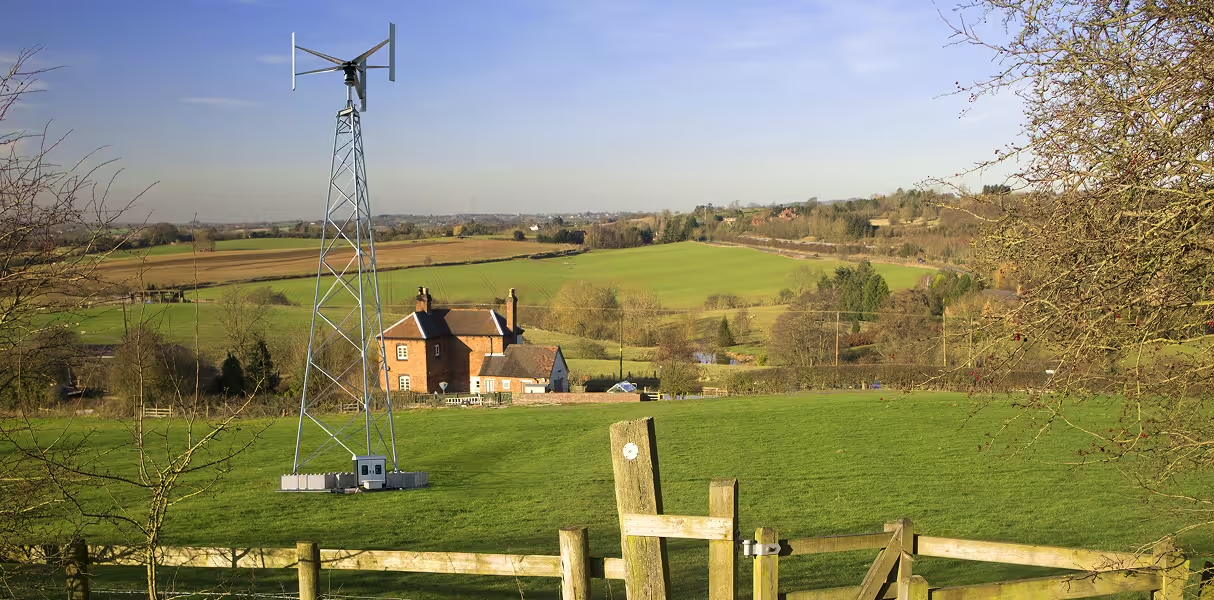
Wind Turbines
Small wind turbines that harness renewable power for consistent energy generation.
-
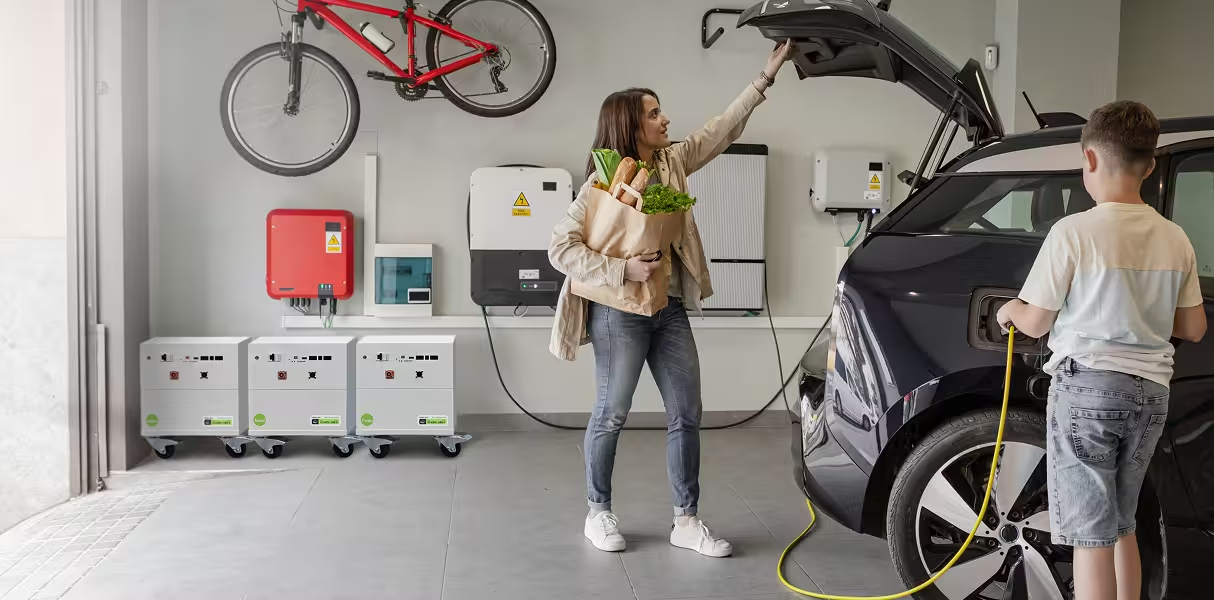
Energy Storage
Store surplus power to ensure uninterrupted energy supply, even during outages.
Own Power Generation for Energy Independence
The UK and Ireland are entering a new phase of energy transition, defined by renewable adoption, but also by infrastructure limits. Grid congestion, rising costs, and planning delays are forcing businesses and property owners to rethink how energy is generated and consumed. Our 9 kW and 20 kW wind turbines are designed for rural and semi-rural properties where wind resources are strong and grid reliability can be limited.
From the Scottish Highlands and Islands to rural Ireland, coastal Wales, and the north of England, Freen systems can provide reliable off-grid and grid-tied energy generation year-round. Our EU-manufactured sodium-ion storage offers a safe, lithium-free alternative to conventional batteries. Whether you are a business facing connection delays, a farm looking to reduce operating costs, or a property owner seeking long-term energy stability, wind and storage together offer a reliable and future-proof solution.

Find out which energy system is best for your site.
Get consultationReady to Take Charge of Your Own Energy?
Whether you are a homeowner, farmer, or business, Freen has an energy system sized for you. Browse our products, get in touch, or explore our partnership program.
-
Send us your request for a quote
-
Shop wind turbines & energy storage
-

Become a Freen partner
FAQ
-
They often outperform solar in UK conditions. The British Isles have some of the highest average wind speeds in Europe, particularly in Scotland, coastal Ireland, Wales, and northern England. Average wind speeds typically range around 5.0 m/s in the UK and 5.5 m/s in Ireland, creating favourable conditions for small wind systems. Unlike solar panels, wind turbines generate power in overcast conditions and throughout winter months, making them well-suited to the local climate year-round. For example, at average wind speeds of 5–6 m/s, a Freen-9 turbine can generate approximately 6.1–12.1 MWh annually, while a Freen-20 can produce around 17.9–30.2 MWh per year, depending on site conditions.
-
In England, Scotland, and Wales, small wind turbines may qualify as permitted development under certain conditions — particularly for freestanding installations at rural or agricultural properties — but this depends on height, proximity to buildings, and local authority rules. In Ireland, similar exemptions exist for certain property types. We recommend checking with your local planning authority before installation. Freen can support you with technical documentation for planning applications.
-
The 9 kW turbine suits homes, smallholdings, and small businesses with moderate electricity needs. The 20 kW model is designed for farms, larger rural businesses, and commercial premises with higher consumption. Our team can help size the right turbine based on your annual electricity usage and wind conditions at your site.
-
Scope 2 emissions cover the greenhouse gases associated with purchased electricity. Buying renewable energy certificates (RECs or REGOs) reduces your reported Scope 2 figure on paper, but generates no actual on-site clean power. A Freen wind turbine produces metered, verifiable electricity on your premises, which directly displaces grid electricity and constitutes genuine Scope 2 reduction under both market-based and location-based accounting methods. This is the kind of evidence that satisfies ESG auditors, investors, and supply chain sustainability requirements — not just a certificate. Combined with our European-manufactured sodium-ion storage, which contains no conflict minerals, a Freen system also strengthens your Scope 3 supply chain narrative.
-
Yes. In Great Britain, the Smart Export Guarantee (SEG) requires licensed energy suppliers to pay you for surplus electricity you export to the grid. Rates vary by supplier. In Ireland, similar export tariff schemes exist under SEAI guidelines. A Freen system paired with battery storage lets you maximise self-consumption first, then export any remaining surplus for additional income.
-
Yes, when configured with battery storage. The sodium-ion storage units can provide backup power during grid outages, making Freen systems particularly valuable for rural properties in Scotland, Ireland, and Wales where power cuts are more frequent. Fully off-grid configurations are also available for properties without a grid connection.
-
Yes, we already have a network of partner installers and distributors. However, we also actively seek qualified installation partners, energy consultants, and regional distributors across England, Scotland, Wales, and Ireland. If you are an installer or trade buyer interested in Freen products, visit our partnership page to learn about our program, margins, and support offer.
Ready to take the first step?

Thank you for
contacting us!
Your message has been successfully sent. Our team will review it and get back to you as soon as possible. We appreciate your interest in our products and services.

We use cookies
Our website uses cookies to collect statistical visitor data and track interaction with direct marketing communication. If you agree, press ‘I agree‘. We will not place cookies on your device if you do not agree. However, certain functions of the website may not function properly or may not function at all. You may withdraw your consent at any time. Please see our Privacy Policy for more information about cookies, data they collect, who may access them, and your rights.