Sodium-ion batteries provide safer, longer-lasting home energy storage with -30°C to +60°C tolerance and 10,000+ cycles. This guide explains how the technology works and why it outperforms lithium-ion in 2026.
What Are Sodium-Ion Batteries?
Sodium-ion batteries operate on similar principles to lithium-ion technology but use abundant sodium ions as charge carriers instead of lithium. This fundamental difference delivers significant advantages in safety, sustainability, and cost while maintaining comparable energy density and efficiency.
The technology has matured rapidly, with commercial products now achieving over 97% round-trip efficiency and 10,000+ cycle lifespans. According to the International Energy Agency (IEA), sodium-ion batteries are positioned to capture a significant share of the stationary energy storage market by 2030, driven by their superior safety profile and lower raw material costs.
Key characteristics of modern sodium-ion batteries include:
- • Enhanced safety – Layered oxide chemistry resists thermal runaway and fire risks
- • Extreme temperature tolerance – Operates reliably from -30°C to +60°C without performance degradation
- • Long cycle life – Over 10,000 cycles with greater than 60% end-of-life capacity retention
- • Sustainable materials – Sodium is 1,000x more abundant than lithium, reducing supply chain risks
Learn more about the underlying sodium-ion battery chemistry from technical sources.
How Sodium-Ion Technology Works
Sodium-ion batteries use a layered oxide cathode structure where sodium ions move between the cathode and anode during charge and discharge cycles. The electrolyte facilitates ion transport while the separator prevents electrical short circuits.
During charging, sodium ions move from the cathode to the anode through the electrolyte. During discharge, ions flow back to the cathode, releasing electrons that power your home. This reversible process repeats thousands of times with minimal degradation.
Modern designs implement partial capacity utilization strategies. By keeping the battery consistently undercharged and under-discharged, manufacturers significantly reduce the chance of thermal runaway, even under high load conditions.
Sodium-Ion vs. Lithium-Ion: Head-to-Head Comparison
Understanding the differences between sodium-ion and lithium-ion technologies helps inform your home battery purchase decision. While lithium-ion dominated the market for two decades, sodium-ion now offers compelling advantages for residential energy storage.
| Feature | Sodium-Ion | Lithium-Ion (LFP) |
| Discharge Temperature Range | -30°C to +60°C | -10°C to +50°C |
| Safety Rating | Excellent (fire-resistant) | Good (thermal runaway risk) |
| Cycle Life | >10,000 cycles | 3,000-6,000 cycles |
| Cooling Requirements | Natural convection | Active cooling often required |
| Round-Trip Efficiency | >97% | 95-97% |
The most significant advantage emerges in extreme climates. Sodium-ion batteries maintain full performance at -30°C where lithium-ion capacity drops significantly, making them ideal for northern European and Scandinavian installations.
Freen Sodium-Ion Battery Systems: Technical Specifications
Freen offers two sodium-ion battery series designed for residential and small commercial home energy storage applications. Both models feature layered oxide chemistry, natural convection cooling, and modular scalability.
The Freen-BSL targets installations requiring simpler low-voltage architecture, while the Freen-BSH optimizes efficiency for larger systems requiring higher voltage integration.
| Specification | Freen-BSL (Low Voltage) | Freen-BSH (High Voltage) |
| Nominal Voltage | 48V | 288V |
| Application Focus | Residential, small commercial | Residential, commercial, grid support |
| Discharge Temperature Range | -30°C to +60°C | -30°C to +60°C |
| Cycle Life | >10,000 cycles (>60% EOL) | >10,000 cycles (>60% EOL) |
| Round-Trip Efficiency | >97% | >97% |
| Cooling Method | Natural convection | Natural convection |
| Communication Protocol | CAN / RS485 | CAN / RS485 |
Download detailed technical specifications: Freen-BSL datasheet and Freen-BSH datasheet.
Engineered Safety: The Freen Advantage
Safety represents the primary advantage of sodium-ion chemistry over lithium-ion. Freen batteries implement multiple layers of protection to eliminate fire, explosion, and thermal runaway risks.
The layered oxide cathode structure resists exothermic reactions even when damaged. Unlike lithium-ion cells that can ignite when exposed to moisture or oxygen, sodium-ion cells remain stable under mechanical stress.
Engineered safety features include:
- • Partial capacity utilization – Batteries operate below maximum charge limits to prevent thermal stress
- • Natural convection cooling – No fans or active cooling systems that can fail
- • Structural reinforcement – Robust casing prevents moisture and oxygen ingress
- • Smart monitoring – CAN/RS485 communication enables real-time health tracking
These features make sodium-ion batteries ideal for indoor residential installation without specialized fire suppression systems.
Applications and Use Cases
Sodium-ion home batteries serve diverse applications across residential, commercial, and industrial sectors. The technology’s safety profile and temperature tolerance expand deployment possibilities.
Primary applications include:
- • Grid-tied solar storage – Store excess solar generation for evening use to maximize self-consumption
- • Off-grid systems – Primary energy storage for remote homes, farms, and telecommunications sites
- • Emergency backup power – Critical load protection during grid outages
- • Wind energy integration – Pair with small wind turbines for hybrid renewable systems
The 48V architecture of the BSL series suits simpler installations, while the 288V BSH series optimizes efficiency for larger systems requiring higher power output.
Economics and Total Cost of Ownership
Sodium-ion batteries deliver competitive economics through longer lifespan, lower maintenance, and superior performance in extreme conditions. While upfront costs may match lithium-ion, total cost of ownership heavily favors sodium-ion over a 10+ year horizon.
Key economic advantages include:
- • Lower cost per cycle – 10,000+ cycles vs. 3,000-6,000 for lithium-ion spreads capital cost thinner
- • No cooling system costs – Natural convection eliminates fan maintenance and energy consumption
- • Reduced insurance costs – Lower fire risk may qualify for property insurance discounts
- • Extended lifespan – 20+ year operational life exceeds typical home ownership periods
Browse current models and configurations at the Freen shop to compare options and bundle with renewable generation systems.
Installation and Integration
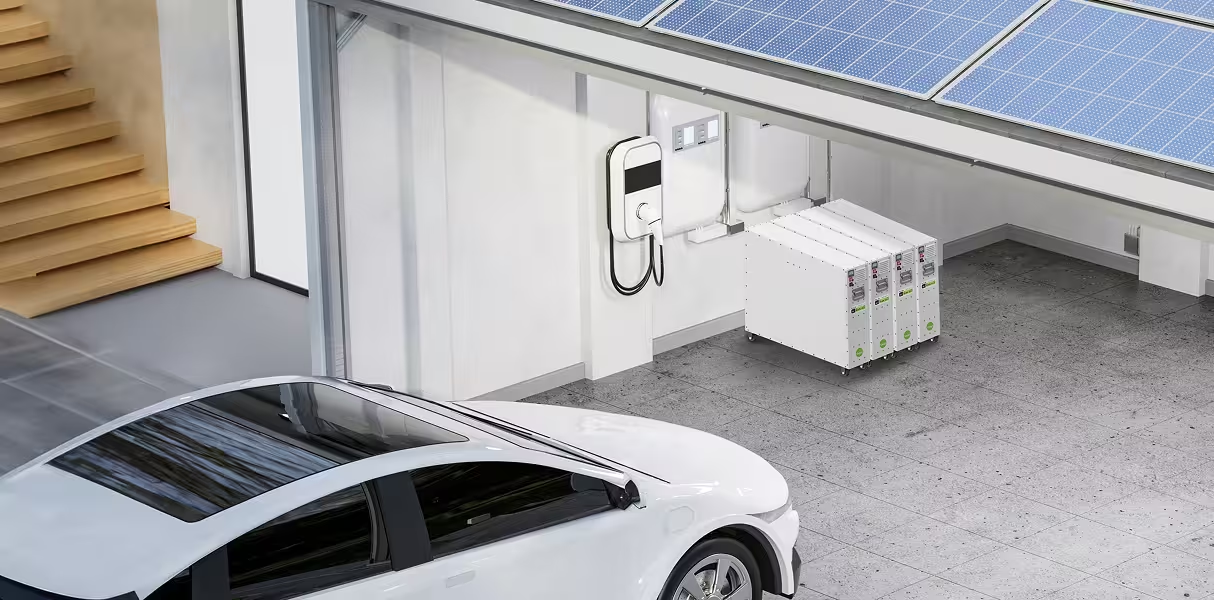
Freen sodium-ion batteries feature floor-mounted installation with modular configurations. The design allows flexible system sizing to meet different energy storage needs while maintaining a compact footprint.
Installation requirements include:
- • Indoor location – Protected indoor installation is required for optimal longevity
- • Inverter compatibility – The 48V BSL is compatible with most standard residential inverters
- • Communication – CAN/RS485 protocols enable seamless smart energy management integration
- • Professional setup – Certified electricians ensure code compliance and safe grid interconnection
Frequently Asked Questions
-
Modern sodium-ion batteries deliver over 10,000 full charge-discharge cycles while retaining greater than 60% of their end-of-life capacity. This translates to 20+ years of reliable daily operation.
-
Yes. Sodium-ion batteries maintain consistent performance and can discharge reliably in temperatures as low as -30°C, making them far superior to lithium-ion for cold climate installations.
Making Your Decision
Choosing sodium-ion battery storage delivers immediate benefits in safety, performance, and longevity while supporting a sustainable energy transition. The technology has matured from experimental to commercial-ready, with products offering proven, reliable performance.
Key decision factors favor sodium-ion when extreme temperatures, indoor safety, and long-term value are top priorities. For detailed system design and personalized recommendations, explore our advanced sodium-ion batteries or contact our technical team.
Ready to upgrade to sodium-ion energy storage?
Discover how Freen’s sodium-ion batteries can provide safer, more reliable home energy storage with superior performance in any climate.
Contact us at contact@freen.com for a free consultation and system design.